Intro to AI Bills of Materials (AI-BOMs): The Next Frontier in Supply Chain Security


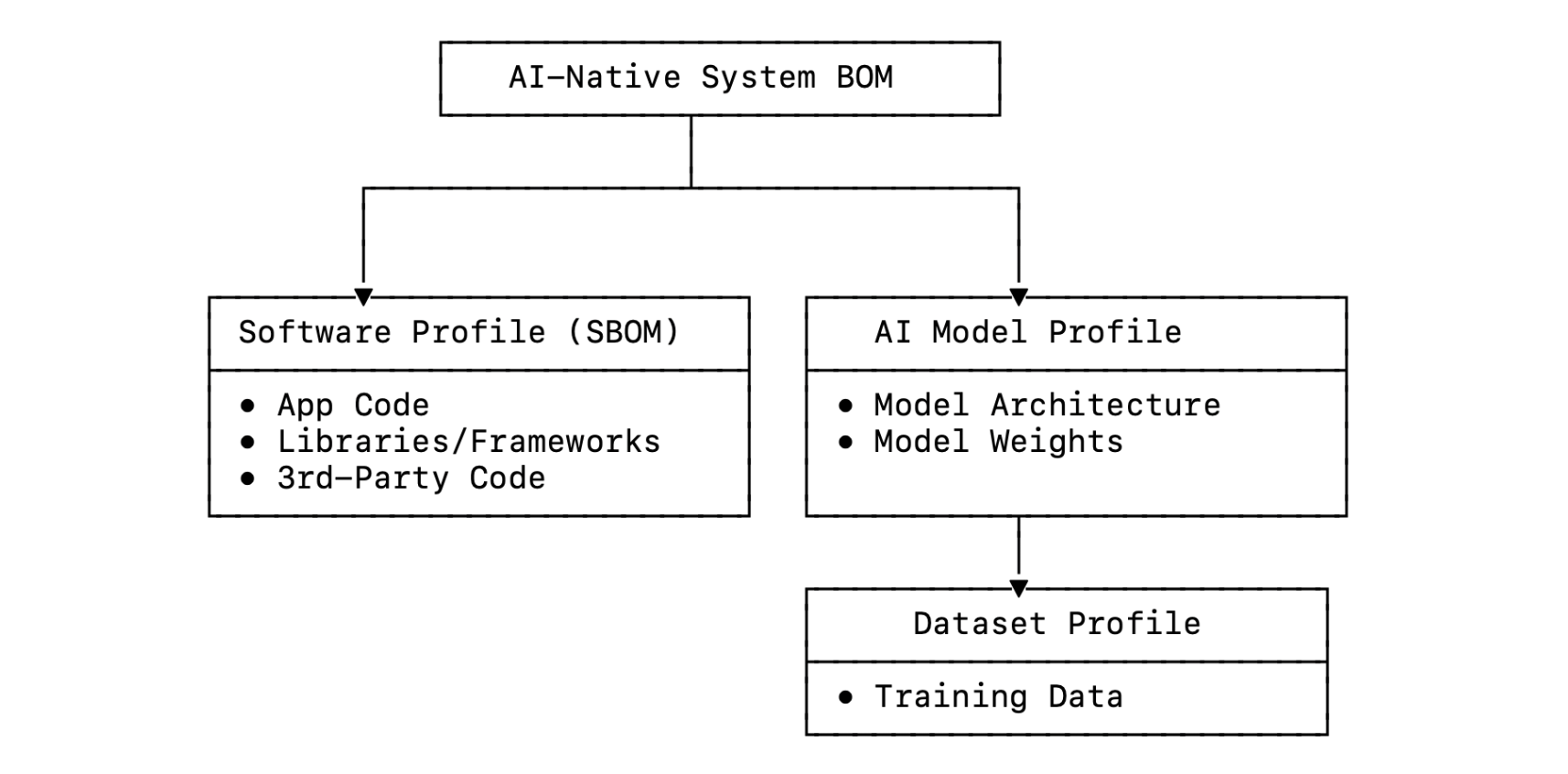
- An AI Bill of Materials (AI-BOM) is a machine-readable inventory of the components used to build and operate an AI system. It extends software dependency visibility to AI-specific assets, including models, datasets, prompts, APIs, and infrastructure.
- AI-BOMs help organizations assess supply chain risks, identify unauthorized AI usage, respond to incidents, and maintain governance records.
- AI-BOMs should be versioned, stored centrally, and updated as models, datasets, dependencies, and services change.
For the last several years, the cybersecurity industry has been running a marathon to secure the traditional software supply chain. We’ve collectively realized that you can’t protect what you don’t know you’re running, which is exactly why the Software Bill of Materials (SBOM) went from a niche concept to a non-negotiable enterprise requirement.
But just as organizations are starting to get a handle on their standard software dependencies, the tech stack evolved underneath us. Generative AI and autonomous AI agents have exploded into production workflows, bringing along a completely new, highly complex asset class.
Securing software today no longer just means tracking open-source libraries and APIs; it means tracking data sources, foundation models, and training pipelines. If we apply yesterday’s security frameworks blindly to today’s AI architectures, we leave massive blind spots in our security and governance posture. Here’s what you need to know.
What is an AI Bill of Materials (AI-BOM)?
An AI Bill of Materials (AI-BOM) is a machine-readable inventory of the components used to build and operate an AI system. Similar to a Software Bill of Materials (SBOM), it provides a structured record of the technologies, assets, and dependencies that contribute to an application’s functionality.
While SBOMs provide visibility into software dependencies, AI-BOMs extend that visibility to the models, datasets, services, and other assets that influence how AI systems behave. The result is a more complete picture of the resources that power modern AI applications.
Core Components
An AI-BOM should document the components that power an AI system and how they relate to one another. CISA and G7 partners’ Software Bill of Materials for AI – Minimum Elements, released in May 2026, provides voluntary guidance that supplements general SBOM minimum elements. It offers a practical starting point for building a more complete inventory.
- Models: Identify the models used within the application, including foundation models, fine-tuned models, embedding models, and other machine learning assets. Record the following details to help teams distinguish between model versions and understand their origins and intended uses:
- Model name, version, and unique identifier
- Provider or producer
- License and usage restrictions
- Model architecture and training details
- References to model cards or technical documentation
- Datasets and Data Sources: Document the datasets and sources used for training, fine-tuning, testing, retrieval-augmented generation (RAG), and inference. Examples include internal knowledge bases, customer support tickets, public datasets, and proprietary research databases. Useful details include each dataset’s source, version, license, collection and processing methods, and whether it contains personal or sensitive information. Record relationships between datasets and the models or workflows that use them.
- Software Dependencies and Infrastructure: Track the software and infrastructure needed to build and operate the system, including open source packages, frameworks, containers, hardware, cloud services, and vector databases. Connect these records to existing SBOMs where possible to maintain visibility across both software and AI-specific dependencies.
- System Context and Data Flows: Describe the application’s intended purpose, its major components, and how information moves between them. Include external APIs, connected tools, and the data exchanged with third-party services. This context helps teams understand how individual assets contribute to the deployed system.
- Security and Governance Information: Include or reference relevant security controls, known vulnerabilities, assessments, and policies. Organizations can also add ownership, risk classifications, and approval status to connect the inventory with their internal governance processes.
- Evaluation and Performance Information: Link to relevant model evaluations and system performance measures, identifying the version and testing conditions they describe. This helps teams interpret results in context and identify when changes warrant reassessment.
- Inventory Metadata: Record who created the AI-BOM, when it was generated, its version and format, and the tools used to produce it. Keeping this information current helps teams determine whether the inventory reflects the system they are reviewing.
AI-BOMs vs. SBOMs
AI-BOMs and SBOMs (software bills of materials) share a common goal: increasing transparency within complex technology ecosystems. Both provide machine-readable inventories that help organizations understand what components exist within a system, where they originated, and how they relate to one another. However, they focus on different layers of the technology stack.
An SBOM documents the software components used to build an application, including libraries, packages, containers, operating systems, and other dependencies. An AI-BOM extends this concept to AI systems by documenting additional artifacts such as models, datasets, prompts, APIs, and AI-specific infrastructure.
In short, the two documents answer different questions:
- An SBOM answers… What software is running in this application?
- An AI-BOM answers… What is powering this AI system and influencing its outputs?
As AI becomes increasingly embedded in business-critical workflows, organizations will likely need both SBOMs and AI-BOMs to achieve complete visibility across their software and AI supply chains. Together, these artifacts provide a more comprehensive foundation for risk management, security, compliance, and governance. In practice, an AI-BOM doesn’t have to be a separate file. Both CycloneDX and SPDX v3 can describe AI components alongside software components in a single BOM, or you can maintain a standalone AI-BOM and link it to your SBOMs. Which approach fits depends on how your teams generate, store, and consume these inventories.
Why AI Transparency Is Non-Negotiable in 2026
AI has moved beyond experimentation. Organizations are embedding generative AI into customer-facing applications, internal workflows, development tools, and AI agents that can take autonomous actions. At the same time, AI systems are becoming increasingly complex, often combining multiple models, datasets, APIs, frameworks, and third-party services into a single application.
For security, compliance, and engineering teams, that complexity creates a fundamental challenge: you can’t secure, govern, or assess what you can’t see. AI-BOMs help address this challenge by providing visibility into the components that make up an AI system, enabling organizations to better understand their AI supply chains and manage risk more effectively.
Benefits of AI-BOMs
- Improve visibility into what is running in production: Many organizations struggle to answer basic questions about their AI deployments, such as which models are currently in use, which datasets influence their outputs, and so on. AI-BOMs provide a centralized inventory of these assets, making it easier to understand how AI systems are assembled and maintained.
- Strengthen AI supply chain security: Modern AI applications rely on a growing network of open source frameworks, software dependencies, external APIs, and model providers, and each component introduces potential security risks. By documenting these relationships, AI-BOMs help security teams identify dependencies, assess third-party risk, and gain greater visibility into the broader AI supply chain.
- Reduce shadow AI: Employees increasingly adopt AI tools without formal approval or oversight. This phenomenon—often referred to as Shadow AI—can introduce security, privacy, compliance, and intellectual property risks. AI-BOMs support governance efforts by creating an authoritative record of approved models, services, and AI workflows, making it easier to identify and manage unauthorized AI usage.
- Accelerate incident response: When a vulnerability, model issue, or third-party service disruption is discovered, organizations need to quickly determine what systems may be affected. AI-BOMs help teams identify where specific models, APIs, datasets, or dependencies are being used, reducing investigation time and improving response efforts.
- Support AI governance: Organizations are increasingly establishing governance frameworks for AI development and deployment. These programs often require documentation around model ownership, approved data sources, risk assessments, and usage policies. AI-BOMs provide a structured way to capture and maintain much of this information, helping teams operationalize AI governance practices at scale.
- Respond to growing regulatory expectations: Some requirements are already in effect (more on this below), while others will be introduced over the next several years. Although current frameworks do not universally require an AI-BOM, maintaining a structured inventory can help organizations establish the traceability and documentation needed to assess applicable obligations, prepare for audits, and respond as requirements evolve. An AI-BOM provides a foundation for these efforts but must be combined with broader risk management, oversight, and disclosure processes.
How to Create Your First AI-BOM
Unlike SBOMs, which benefit from established standards and tooling, AI-BOMs are still evolving. However, organizations don’t need to wait for a universal standard to begin documenting the components that power their AI systems. The most effective approach is to start by inventorying the models, datasets, dependencies, and services used throughout your AI workflows and then build more mature governance processes over time.
AI-BOM Formats & Standards
Established standards already support documenting AI systems, though adoption, tooling, and implementation practices continue to evolve.
CycloneDX
CycloneDX is a widely adopted bill of materials standard with dedicated AI/ML capabilities. It supports documenting models, datasets, dependencies, and model cards that capture details such as intended use and evaluation results. Organizations already using CycloneDX can extend their existing inventory practices to AI-related assets. AI components can be recorded in the same BOM as your software dependencies, or in a dedicated AI-BOM.
SPDX
SPDX is another widely used standard for documenting software components, licenses, and dependencies. SPDX 3.0 introduced dedicated AI and Dataset profiles, enabling organizations to capture structured information about AI models, their associated data, and other AI-specific characteristics. Because the AI and Dataset profiles are part of the same specification, AI information can sit in the same document as software information or in its own.
Internal AI Inventories
Organizations can also maintain internal AI inventories tailored to their governance requirements, tracking models, datasets, APIs, prompts, ownership, risk classifications, and approval status. Aligning these inventories with established standards helps teams exchange information and integrate it into existing security and governance workflows.
As adoption grows, AI-BOM tooling and implementation practices will continue to mature, making these inventories easier to generate, maintain, and use across the AI lifecycle.
Steps for Generating Your First AI-BOM
- Define the scope: Before documenting anything, determine what system the AI-BOM will represent. For example, will it cover training, inference, or both? Is this for a single application or an entire platform?
- Choose a documentation format: Based on the standards outlined above, select a format that aligns with your existing software supply chain practices. While standards continue to evolve, the goal is consistency and maintainability, not perfection.
- Collect component information: Gather information about the models, datasets, dependencies, APIs, and other assets that power the system. Refer back to the components section above for more details.
- Establish ownership: Assign responsibility for maintaining the AI-BOM, whether an engineering team, security team, or special committee. Without ownership, inventories quickly become outdated.
- Validate the information: Review the AI-BOM for completeness and accuracy, verifying that components are correct, versions are accurate, governance is up-to-date, and so on.
How to Implement AI-BOMs in Your CI/CD Pipeline
The value of an AI-BOM increases significantly when it is generated and maintained automatically. Manual inventories quickly become outdated as models, dependencies, datasets, and services change. By integrating AI-BOM creation into CI/CD pipelines, organizations can improve accuracy while reducing operational overhead.
Leverage Existing SBOM Management Practices
The path to AI-BOM adoption may look familiar. Many organizations began their software supply chain security journeys by generating SBOMs, centralizing inventories, and establishing governance processes around software dependencies. AI-BOMs build on these same foundations, extending visibility beyond software to the broader AI supply chain. For this reason, organizations that already generate, manage, and analyze SBOMs have a significant head start when adopting AI-BOMs.
As AI becomes embedded within modern applications, organizations will increasingly need visibility into both traditional software dependencies and AI-specific components. Treating AI-BOMs as a natural extension of existing SBOM management practices can help teams scale governance efforts without introducing entirely new workflows or tooling silos.
Generate AI-BOMs Automatically
Whenever possible, AI-BOM creation should be integrated directly into build and deployment workflows. Automated generation helps ensure that new dependencies are captured, model updates are recorded, infrastructure changes are documented, and AI inventories remain current.
This approach mirrors SBOM best practices, where inventories are generated as part of the software development lifecycle rather than maintained manually.
Store AI-BOMs Alongside Other Build Artifacts
AI-BOMs should be versioned and stored in a centralized location where they can be accessed by development, security, compliance, and audit teams.
Common storage locations include:
- Artifact repositories
- Source control systems
- Governance platforms
- Internal asset inventories
Maintaining historical records can also simplify audits and incident investigations.
Integrate With Governance Workflows
AI-BOMs become significantly more valuable when integrated into broader software supply chain security programs. When combined with existing processes for inventory management, policy enforcement, risk assessment, and compliance reporting, AI-BOMs help organizations maintain visibility into AI assets throughout their lifecycle rather than treating governance as a point-in-time exercise. Link inventory records to the system’s regulatory classification, applicable obligations, and responsible owners so teams can identify which requirements apply and what additional evidence or controls are needed.
Continuously Review and Update
AI systems evolve rapidly. Models are updated, datasets change, APIs are replaced, and new AI agents are introduced into production environments. Organizations should establish workflows that continuously review and refresh AI-BOMs to ensure they accurately reflect the current state of deployed systems.
As AI adoption continues to accelerate, organizations that automate AI-BOM generation and integrate it into existing CI/CD pipelines will be better positioned to maintain visibility across both their software and AI supply chains.
AI-BOMs and Emerging Governance Frameworks
While AI-BOMs are still evolving, a growing number of regulations, standards, and governance frameworks emphasize the need for transparency into AI systems. Although none currently mandate a universal AI-BOM format, the inventories and documentation provided by AI-BOMs can help organizations support many of these requirements.
- EU AI Act: The Act’s requirements apply in stages, with general-purpose AI model obligations and certain transparency rules already in effect, while high-risk requirements follow in 2027 and 2028. AI-BOMs can contribute to the documentation and traceability needed for applicable obligations, but must be combined with broader compliance processes, including risk assessment and required disclosures.
- NIST AI Risk Management Framework (AI RMF): The NIST AI RMF provides guidance for identifying, assessing, and managing AI risks throughout the AI lifecycle. While it does not prescribe a specific documentation format, the framework emphasizes transparency, traceability, and governance. AI-BOMs can help operationalize these principles by documenting the components and dependencies that influence AI behavior.
- ISO/IEC 42001: ISO/IEC 42001 is the first international management system standard specifically designed for AI. It provides guidance for establishing, implementing, and maintaining an AI management system, including governance, accountability, risk management, and oversight practices. AI-BOMs can serve as a foundational inventory that supports many of these governance and documentation requirements.
- Internal AI governance programs: Many organizations are establishing their own internal governance programs to manage AI adoption. These programs often require documentation around approved models, data sources, ownership, risk classifications, and acceptable use policies. AI-BOMs provide a centralized record of this information, helping organizations maintain visibility into AI systems and apply governance consistently across teams.
While these frameworks differ in scope and objectives, they share a common theme: organizations are increasingly expected to understand the components, dependencies, and data sources behind the AI systems they develop and deploy. AI-BOMs can help provide that visibility.
The Future of AI Supply Chain Security
A decade ago, many organizations had limited visibility into the software components running across their environments. Today, SBOMs are increasingly viewed as a foundational element of software supply chain security. AI systems are creating a similar challenge. As organizations adopt more models, datasets, AI services, and autonomous agents, they will need the same level of visibility and governance that SBOMs brought to software. AI-BOMs represent the next step in that evolution.
Learn what it takes to bring open source AI models under the same governance framework you apply to the rest of your software supply chain:

AI-BOM FAQs
What is an AI Bill of Materials?
An AI Bill of Materials (AI-BOM) is a machine-readable inventory of the components used to build and operate an AI system. It documents the assets, dependencies, and relationships that power the system and influence its behavior.
How is an AI-BOM different from an SBOM?
An SBOM documents software components such as libraries, packages, containers, and operating systems. An AI-BOM extends that inventory to include AI-specific assets such as models, datasets, prompts, APIs, and infrastructure.
What should an AI-BOM include?
An AI-BOM should document models, datasets and data sources, software dependencies and infrastructure, system context and data flows, security and governance information, evaluation results, and inventory metadata. It should also record how these components relate to one another.
What formats can organizations use for AI-BOMs?
CycloneDX supports documenting AI models, datasets, dependencies, and model cards. SPDX 3.0 includes AI and Dataset profiles. Organizations can also maintain internal AI inventories aligned with established standards and their governance requirements.
Can an AI-BOM help with compliance and governance?
An AI-BOM provides component inventories and traceability that can contribute to documentation for the EU AI Act, NIST AI Risk Management Framework, ISO/IEC 42001, and internal governance programs. The inventory must be combined with broader risk management, oversight, and disclosure processes; it does not establish compliance on its own.