

In the fast-moving world of Kubernetes and CI/CD pipelines, “compliance” can often feel like a manual bottleneck in a high-speed engine. As organizations across the Department of War (DoW) and broader federal landscape shift toward containerized applications, the challenge is clear: how do you translate the rigorous requirements of the NIST 800-53 Risk Management Framework (RMF) into the ephemeral, automated world of containers?
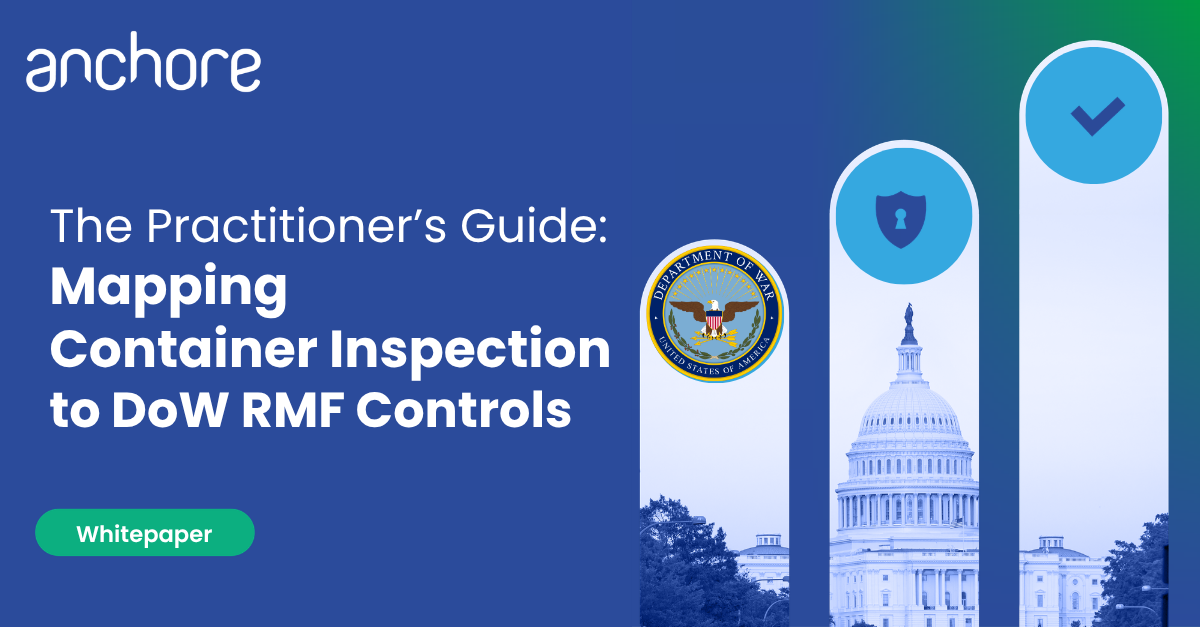
Our latest white paper, “The Practitioner’s Guide: Mapping Container Inspection to DoW RMF Controls,” provides the technical blueprint for doing exactly that.
Moving Beyond Point-in-Time Scanning
Traditional security models often fail when applied to containers because they treat compliance as a static event. Containers, however, are ephemeral and disposable. If a container fails or a new vulnerability is discovered, it is terminated and replaced—not patched in place.
Anchore Enterprise addresses this by shifting from reactive scanning to proactive policy enforcement. By using Policy-as-Code, security teams can bake compliance directly into the build process, ensuring that every image meets cybersecurity standards before it ever hits a production registry.
The Technical Mapping: Platform vs. Policy
Achieving an Authority to Operate (ATO) requires proving that specific controls are met. The guide breaks down how Anchore Enterprise supports these controls through two primary mechanisms:
- Platform Capabilities: Native product features like Role-Based Access Control (AC-3), Event Logging (AU-2), and System Component Inventory (CM-8).
- Policy-as-Code Capabilities: Granular checks that inspect the “guts” of a container, such as blocking unauthorized software (CM-7), detecting unencrypted secrets (IA-5(7)), or validating image provenance (SR-4).
Deep Dive into Specific Control Families
The guide provides an exhaustive matrix for practitioners, including:
- Configuration Management (CM): Establishing baseline configurations for Dockerfiles using policy-as-code (CM-2) and conducting impact analyses via SBOM generation (CM-4).
- System and Information Integrity (SI): Automating flaw remediation status and alerting on new vulnerabilities through continuous monitoring (SI-2, SI-5).
- Access Control (AC): Enforcing least privilege by ensuring containers aren’t running as root and limiting registry access (AC-6).
A detailed guide mapping automated container inspections directly to DoW RMF and NIST security controls.
Want to learn more about our RMF and NIST 800-53 coverage?
Explore how to Automate NIST Compliance and SSDF Attestation in your CI/CD pipeline or read our blog on Deep Container Analysis to see how we go “Beyond the CVE”.