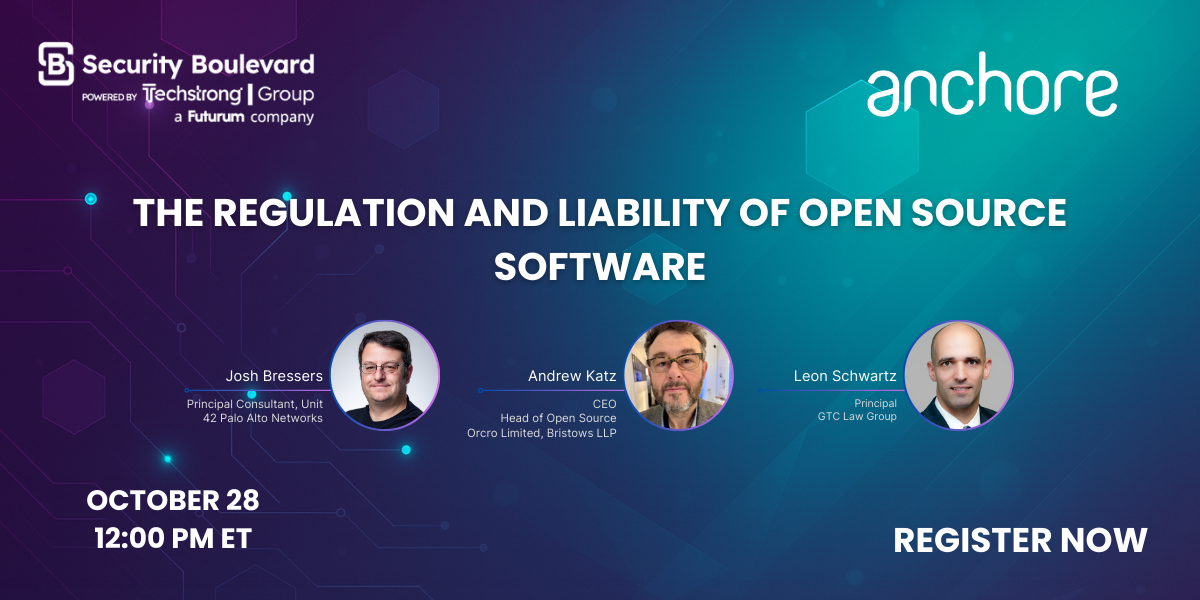



The EU’s Cyber Resilience Act (CRA) is fundamentally changing how we buy and build software. This isn’t just another regulation; it’s re-shaping the market landscape. We sat down with industry experts Andrew Katz (CEO, Orcro Limited & Head of Open Source, Bristows LLP), Leon Schwarz (Principal, GTC Law Group), and Josh Bressers (VP of Security, Anchore) to discuss how to best take advantage of and prepare for this coming change .
The key takeaway? You can either continue to view compliance as a “regulatory burden” or invert the narrative and frame it as a “competitive differentiator.” The panel revealed that market pressure is already outpacing regulation, and a verifiable, automated compliance process is the new standard for winning deals and proving your company’s value.
The “Compliance Cascade” is Coming
Long before a regulator knocks on your door, your biggest customer will. The new wave of regulations creates a shared responsibility that cascades down the entire supply chain.
As Leon Schwarz explained, “If you sell enough software… you’re going to find that your customers are going to start asking the same questions that all of these regulations are asking”. Andrew Katz noted that this responsibility is recursive: “[Your] responsibility will actually be for all components at all levels of the stack. You know, it doesn’t matter which turtle you’re sitting on” .
The panel made it clear: the “compliance cascade” is about to begin. Once one major enterprise in your supply chain takes the EU CRA seriously, they will contractually force that requirement onto every supplier they have. This is a fundamentally different pressure than traditional, internal audits.
EU CRA Compliance as Market Differentiator
During the discussion, Leon Schwarz described the real-world pressure this compliance cascade creates for suppliers. His “big fear is that during diligence, somebody’s going to come in and say, ‘You didn’t do the reasonable thing here. You didn’t do what everybody else is doing'”.
That fear is the sound of the market setting a new baseline. As the “compliance cascade” forces responsibility down the supply chain, “doing what everyone else is doing” becomes the new definition for what is “reasonable” compliance expectations during procurement. Any supplier who isn’t falling in line becomes the odd one out—a high-risk partner. You will be disqualified from contracts before you even get a chance to demonstrate your value.
But this creates a fundamental, short-term opportunity.
In the beginning, many vendors and suppliers won’t be compliant. Proactive, EU CRA-ready suppliers will be the exception. This is the moment to re-frame the challenge: compliance isn’t a hurdle to be cleared; it’s a competitive differentiator that wins you the deal.
Early adopters will partner with other suppliers who take this change seriously. By having a provable process, they will be the first to adapt to the new compliance landscape, giving them the ability to win business while their competitors are still scrambling to catch up.
A Good Process Increases Your Acquisition Valuation
This new standard of diligence impacts more than just sales; it will materially affect your company’s value during an M&A event.
As Andrew Katz explained, “An organization that’s got a well-run [compliance] process is actually going to be much more valuable; different than an organization where they have to retrofit the process after the transaction has closed”.
An acquirer isn’t just buying your product; they are also buying your access to markets. A company that needs compliance tacked-on has a massive, hidden liability, and the buyer will discount your valuation to compensate for the additional risk.
The Real Goal Isn’t the SBOM; It’s the Evidence
For those new to this, the most critical change is that the new requirement is creating evidence. Just as compliance is shifting from an “annual ritual” to a continuous process, new standards are demanding evidence be collected continuously.
Leon Schwarz summed up the new gold standard for auditors and acquirers: “It’s not enough to have a policy. It’s not enough to have a process. You have to have materials that prove you follow it”. Your process is the “engine” that creates this continuous stream of evidence; an SBOM is just one piece of that evidence.
As Andrew Katz noted, an SBOM is “just a snapshot” , which is insufficient in a world of “continuous development”. But a process that generates SBOMs for every commit, build or artifact, creates a never ending stream of compliance evidence.
CompOps is How You Automate Trust
This new, continuous demand for proof requires a fundamentally different approach: CompOps (Compliance Operations).
With the EU CRA demanding SBOMs for every release and PCI-DSS 4 requiring scans every three months, compliance must become “part of our development and operations processes” . This is where CompOps, which borrows its “resilient and repeatable” principles from DevOps, becomes essential. It’s not about manual checks; it’s about building automated feedback loops.
Leon described this perfectly: “As developers figure out that if [they] use the things in this bucket of compliant components that their code is automatically checked in; those are the components they will default to”. That “bucket” is CompOps in action—an automated process that shapes developer behavior with a simple, positive incentive (a green checkmark) and generates auditable proof at the same time.
Are You Building a Speed Bump or a Navigation System?
The experts framed the ultimate choice: you can treat compliance as a “speed bump” that slows developers and creates friction. Or, you can build a “navigible system”.
A good CompOps process acts as that navigation, guiding developers to the path of least resistance that also happens to be the compliant path. This system makes development faster while automatically producing the evidence you need to win deals and prove your value.
This is a fundamentally different way of thinking about compliance, one that moves it from a cost center to a strategic asset.
This was just a fraction of the insights from this expert discussion. The full webinar covers how to handle deep-stack dependencies, specific license scenarios, and how to get buy-in from your leadership.
To learn how to turn compliance from a burden into your biggest competitive advantage, watch the complete on-demand webinar, “The Regulation and Liability of Open Source Software,” today.